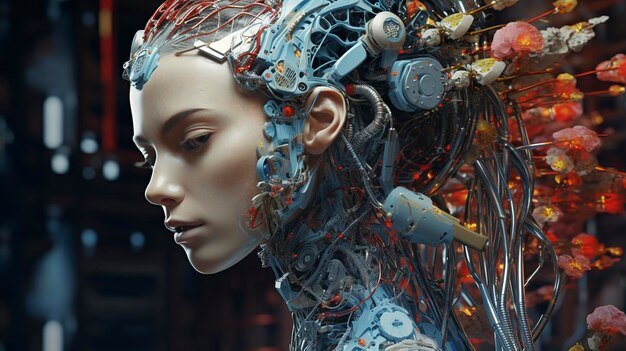
The ground is shifting beneath the feet of creatives worldwide, and the tremors are coming from artificial intelligence. Far from being a niche tech trend, AI is rapidly reshaping how we approach everything from graphic design to music composition. But for those ready to embrace the change, this transformation isn't a threat; it's an unprecedented opportunity for Finding Joy & Purpose: Adapting to AI-Driven Creative Landscapes.
This isn't about becoming a robot; it's about reclaiming your most precious resource: your creative energy. It's about letting machines handle the mundane so you can dive deeper into the magnificent.
At a Glance: Navigating the AI-Driven Creative World
- AI is a collaborator, not a replacement: Human creativity, with its unique blend of emotion, experience, and cultural context, remains irreplaceable.
- Focus on uniquely human skills: Develop storytelling, emotional intelligence, critical thinking, and empathy—these complement AI, they don't compete with it.
- Leverage AI for joy and purpose: Use AI to automate "necessary but not fulfilling" tasks, freeing up your time for the creative work you truly love and value.
- Embrace lifelong learning: Stay curious and experiment with new AI tools and techniques in your field.
- Start small and experiment: Don't try to overhaul your entire workflow at once. Pick one tedious task and see how AI can help.
The AI Revolution in Creative Work: Beyond the Hype
The narrative around AI in creative industries often swings between utopian visions of boundless innovation and dystopian fears of mass job displacement. The reality, as always, lies somewhere in the nuanced middle. AI tools, from Adobe's Sensei to advanced generative platforms, are already streamlining workflows, generating new possibilities, and yes, fundamentally altering job descriptions. A PwC report estimates AI could contribute a staggering $15.7 trillion to the global economy by 2030, a significant portion of which will be fueled by enhanced productivity and innovation within creative sectors.
This isn't just a technological shift; it's a cultural and professional one. While machines excel at speed, data processing, and pattern recognition, they lack the inherently human qualities that truly make art and communication resonate. Our task isn't to compete with AI on its terms, but to lean into our distinct advantages and elevate our craft through intelligent collaboration.
Why Human Creativity Still Reigns Supreme (And Always Will)
Let's be unequivocally clear: the core of human creativity—the spark that ignites a compelling story, the empathy that crafts a resonant message, the lived experience that infuses a design with soul—cannot be fully replicated by algorithms. This "human touch" is what connects us, what moves us, and what fosters genuine understanding.
Think about it:
- Emotions and Experiences: AI can analyze sentiment, but it doesn't feel grief, joy, or longing. It hasn't lived a life that informs its perspective.
- Cultural Context and Nuance: Understanding satire, irony, historical significance, or the unspoken rules of a community requires a depth of human understanding that goes beyond data points.
- Storytelling and Connection: Crafting a narrative that genuinely moves an audience, builds trust, or inspires action relies on intuition, empathy, and an understanding of the human condition. In fields like advertising, human creatives are irreplaceable for crafting compelling narratives that cut through noise.
- Ethical Judgment and Values: Deciding why something should be created, for whom, and what message it should convey involves ethical considerations and value judgments that only humans can make.
This isn't a limitation of AI; it's a celebration of what makes us uniquely human. Your purpose, your joy, and your true value as a creative lies precisely in these areas that AI cannot fully replicate.
Finding Your Joy: Shifting from Dread to Delight with AI
The true power of AI for creatives isn't just in making things faster or cheaper. It's in making your work more joyful and purposeful. The main challenge in adopting new technology often stems from focusing solely on its capabilities, rather than on its ability to solve your problems or remove friction from tasks you genuinely dislike.
Imagine if you could offload all the "necessary but not fulfilling" tasks that constantly drain your energy. What would you do with that freed-up time? This is where AI truly shines: it becomes your intelligent assistant, tackling the grunt work so you can dedicate more hours to the creative endeavors that truly energize you.
Meaningful use cases for generative AI arise when it directly connects to activities that bring value or joy. It's about identifying those transitional tasks—the research, the initial drafts, the data organization, the formatting—that precede the truly enjoyable, value-adding parts of your creative process.
The "Joy-Driven AI Adoption" Framework: A Practical Guide
Ready to redefine your creative process and inject more joy into your daily work? This framework helps you identify where AI can best serve your unique needs and passions.
Step 1: Uncover Your Creative Friction Points
Start by getting brutally honest with yourself. What tasks do you consistently avoid, procrastinate on, or simply dread? These are your "friction points"—the energy sinks in your creative workflow.
Exercise:
- List Five Unenjoyed Tasks: Take a moment to list five tasks you regularly perform as part of your creative work that you genuinely dislike or find tedious.
- Examples: Extensive background research, formatting complex documents, generating multiple variations for a client presentation, writing initial draft copy for a technical brief, organizing large media libraries.
- Ask "What Would I Rather Be Doing Instead?": For each unenjoyed task, identify the more stimulating, creative, or high-value activity it prevents you from doing. This helps frame the benefit.
- Example: Instead of hours of research, I'd rather be conceptualizing the core visual direction. Instead of formatting, I'd rather be refining the nuanced language of a key message.
Step 2: Identify Your Creative Motivation Drivers
What aspects of your creative work truly energize you? What makes you feel alive and purposeful? These are your "motivation drivers"—the activities that make all the effort worthwhile.
- Is it the initial brainstorming phase?
- Is it the deep dive into conceptual development?
- Is it the intricate detailing of a final piece?
- Is it the client interaction where you present your vision?
- Is it mentoring others or collaborating with a team?
Understanding these drivers is crucial because AI's ultimate purpose for you is to clear the path to these fulfilling activities.
Step 3: Connect the Dots: AI as Your Tedium Terminator
Now, bridge the gap between your friction points and your motivation drivers. Can technology handle part or all of those unenjoyed tasks, thereby freeing up time for what you truly love?
- For extensive research: Could an AI summarizer quickly pull key insights from dozens of articles, saving you hours? Could it generate initial background documents?
- For generating variations: Could a generative AI create multiple design layouts, copy options, or musical motifs for you to then curate and refine?
- For administrative tasks: Could AI help organize your calendar, transcribe interviews, or draft routine client communications?
Mini Case Snippet: AI-Powered Project Kickoff
Consider a graphic designer tasked with creating a branding guide for a new eco-friendly startup. - Friction Point: Spending an entire day sifting through competitors' branding, compiling mood boards, and researching market trends.
- Motivation Driver: The actual design work—crafting the logo, selecting typefaces, developing a cohesive visual language.
- AI Solution: The designer uploads the client brief, a few inspiration images, and competitor URLs into an AI assistant. They prompt it to "analyze key brand aesthetics of sustainable startups, identify common visual motifs, and suggest initial mood board themes and color palettes based on current trends."
- Result: Within an hour, the AI provides a comprehensive document with insights, visual suggestions, and even links to relevant articles. The designer now has a robust starting point, saving a full day of "necessary but not fulfilling" research, allowing them to dive straight into the exciting, hands-on design phase.
This isn't about AI doing the design; it's about AI accelerating the groundwork, empowering the human creative to spend more time where their unique talent truly shines.
Step 4: Start Small, Iterate, and Embrace the Learning Curve
Don't feel pressured to integrate every AI tool into your workflow overnight. The most effective tech adoption emphasizes the freedom AI creates.
- Pick One Task: Choose just one of your identified friction points and find a simple AI tool that could potentially assist.
- Experiment: Dedicate a short period to trying it out. Don't expect perfection immediately. AI, like any new skill, requires practice.
- Evaluate: Did it save you time? Did it make the task less tedious? Did it free you up for more enjoyable work?
- Refine: Learn from the experience. Adjust your prompts, try a different tool, or consider how you could integrate it more effectively next time.
This iterative approach is key. Unpacking AI text-to-image anxiety often comes from a fear of the unknown or a feeling of being overwhelmed. Starting small and focusing on tangible benefits can significantly reduce this anxiety, transforming apprehension into excitement for new possibilities. Lifelong learning isn't just a buzzword here; it's an essential strategy for thriving in this evolving landscape. Stay curious, stay updated, and keep exploring new tools and technologies relevant to your field through online courses, workshops, and peer discussions.
Beyond Task Automation: Leveraging AI for Inspiration and Expansion
AI isn't just for automating routine tasks; it can be a powerful catalyst for creative ideation and problem-solving. Think of it as a relentless brainstorming partner, capable of generating ideas you might never have considered on your own.
- Idea Generation: Stuck on a concept? Prompt an AI with your brief and ask for 20 wildly different approaches. It can offer fresh perspectives, keyword combinations, or visual metaphors that spark new directions.
- Overcoming Blocks: Feeling creatively stagnant? Ask AI to analyze your previous successful projects and suggest common themes or styles you might unconsciously gravitate towards. Or, instruct it to create a narrative entirely outside your comfort zone, pushing your boundaries.
- Expanding Possibilities: Use AI to generate variations of an existing idea—different color palettes, alternative musical arrangements, varying writing tones, or diverse character designs. You remain the curator, the editor, and the ultimate decision-maker, but AI provides a broader palette to work from.
- Complex Problem Solving: AI can help dissect complex briefs, identifying underlying constraints or opportunities that might not be immediately obvious. It can summarize vast amounts of information, allowing you to quickly grasp the essence of a challenge.
The interpretative role of the human creative becomes even more crucial here. AI provides the raw material; you provide the discernment, the taste, and the strategic vision to shape it into something meaningful and unique.
Building Your AI-Powered Creative Toolkit: Skills for the Future
To truly thrive in this new landscape, you'll need a blend of enhanced human-centric skills and a growing proficiency in AI-specific applications. This isn't about replacing your existing talents, but augmenting them.
Human-Centric Skills: Your Irreplaceable Edge
These are the qualities that make you uniquely valuable, the bedrock of authentic creative work. Sharpening them means investing in what makes you human.
- Emotional Intelligence & Empathy: Understanding your audience's feelings, needs, and desires is paramount. AI can analyze data about emotions, but it cannot authentically connect or empathize. This is crucial for crafting resonant messages and designs.
- Critical Thinking & Problem-Solving: AI can present solutions, but you need to evaluate their validity, ethical implications, and cultural appropriateness. True problem-solving often involves navigating ambiguity and making qualitative judgments, areas where humans excel.
- Advanced Storytelling: Beyond crafting a coherent plot, human storytelling involves weaving in subtext, symbolism, and emotional arcs that deeply resonate. AI can generate stories, but the human touch elevates them to art.
- Curiosity & Adaptability: The creative landscape will continue to evolve. Your ability to ask "what if?", embrace new tools, and adapt your processes will be a major differentiator.
- Ethical Judgment: Understanding the implications of AI-generated content, copyright, bias, and responsible use is a uniquely human responsibility.
AI-Specific Skills: Your Practical Enablers
These are the technical proficiencies that allow you to effectively wield AI as a creative partner.
- Prompt Engineering: This is the art of communicating effectively with AI. Learning how to phrase your requests precisely, provide context, specify desired formats, and iterate on prompts to get optimal results is a foundational skill. It's like learning to speak a new language, one that opens up new creative possibilities.
- Data Literacy: Understanding what kind of data AI models are trained on, their potential biases, and the limitations of their outputs is vital. This helps you critically evaluate AI suggestions and outputs, rather than accepting them blindly.
- Tool Proficiency: Familiarize yourself with the specific AI tools relevant to your creative niche—whether they are generative AI for text, images, music, or code, or AI-powered assistants for research and workflow optimization. You don't need to be a programmer, but knowing how to operate and integrate these user-friendly interfaces is key.
- AI Ethics & Responsible Use: Be aware of the ethical considerations surrounding AI, including copyright, intellectual property, deepfakes, and bias. Responsible AI use isn't just a corporate mandate; it's a personal responsibility for every creative professional.
Common Misconceptions About AI in Creative Fields
Fear and uncertainty often stem from a misunderstanding of what AI truly is and isn't. Let's address some common myths head-on:
- "AI will replace all human creatives."
- Reality: AI is a tool for augmentation, not outright replacement. While routine, repetitive tasks may be automated, the uniquely human aspects of creativity—empathy, original concept generation, nuanced storytelling, and emotional connection—remain firmly in human hands. AI handles the "how"; humans still define the "why" and "what."
- "I need to be a coder to use AI in my creative work."
- Reality: This couldn't be further from the truth. Most cutting-edge AI tools are designed with user-friendly interfaces, often relying on natural language prompts (i.e., typing in plain English) or simple visual inputs. Your creative intuition is far more valuable than coding knowledge when interacting with these tools.
- "AI will make everyone's work look and sound the same."
- Reality: While AI can generate generic outputs, the human input is what creates uniqueness. Your specific prompts, your unique curation, your distinct aesthetic choices, and your personal interpretation will always ensure your work stands out. AI provides a canvas and brushes; you still paint the masterpiece.
- "It's unethical to use AI in creative work."
- Reality: The ethics of AI in creativity are nuanced and constantly evolving. There are indeed concerns around intellectual property, deepfakes, and bias in training data. However, using AI responsibly as a collaborative tool for efficiency, inspiration, or idea generation is increasingly accepted and even encouraged. Transparency about AI use is often key.
- "AI is too expensive/complicated for independent creatives."
- Reality: Many powerful AI tools offer free tiers or affordable subscriptions, and platforms are becoming increasingly intuitive. The investment in learning how to use them often pays dividends by saving time and enhancing output.
Cultivating a Collaborative Mindset with AI
The most successful creatives in the coming years won't be those who ignore AI, nor those who try to mimic it. They will be those who see AI as a co-pilot, a powerful extension of their own capabilities. This collaborative mindset shifts from an "us vs. them" mentality to one of synergy: human ingenuity blending harmoniously with machine efficiency.
Imagine a world where your most tedious tasks are handled by an unfailingly efficient assistant, leaving you free to focus on the strategic, emotional, and truly original aspects of your craft. This isn't science fiction; it's the present reality for those willing to adapt.
This collaboration also extends to ethical considerations. As creatives, we have a responsibility to use AI tools thoughtfully, considering their impact on our audience, our industry, and the broader creative ecosystem. This includes understanding potential biases in AI outputs, acknowledging AI assistance when appropriate, and ensuring our creative integrity remains paramount.
Your Path Forward: Designing a Joyful, Purpose-Driven Creative Life
The transformation of the creative landscape by AI is not just an external phenomenon; it's an invitation to an internal transformation. It's a call to re-evaluate your relationship with your work, to shed the burdens of the mundane, and to embrace a future where your unique human gifts are amplified, not diminished.
Start today. Review your daily workflow, identify those "necessary but not fulfilling" tasks, and pick one small way an AI tool could help. Experiment. Learn. Most importantly, give yourself permission to explore this new frontier not with fear, but with curiosity and a sense of adventure.
Here are some actionable steps to design your AI-powered, joyful creative life:
- Audit Your Day: Spend a week tracking how you spend your time. Highlight every task that feels like a drain. These are your prime candidates for AI assistance.
- Pick Your First AI Partner: Don't get overwhelmed by choice. Start with a readily available, user-friendly tool like a summarizer, a basic generative text AI, or an AI image tool for mood boards. Focus on one small friction point.
- Prioritize Human-Centric Growth: Dedicate time each week to honing your uniquely human skills: practice storytelling, engage in critical discussions, develop your emotional intelligence through observation and reflection. These are your true superpowers.
- Connect and Learn: Engage with other creatives who are exploring AI. Share experiences, challenges, and successes. Online communities, workshops, and industry events can be invaluable resources.
- Embrace the Iterative Process: The journey of adapting to AI is ongoing. Be patient with yourself, celebrate small victories, and view every experiment as a learning opportunity.
The future of creativity involves a harmonious blend of human ingenuity and machine efficiency. By consciously choosing to leverage AI to handle the tasks that sap your energy, you empower yourself to focus on the work that truly ignites your passion, fulfills your purpose, and brings you genuine joy. This isn't just about surviving the AI era; it's about thriving in it, creating more, and living a richer, more fulfilling creative life.